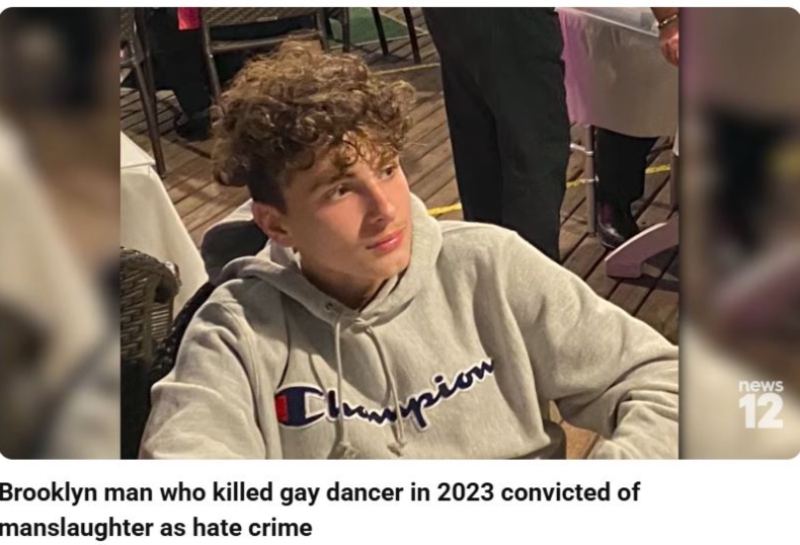
Dmitriy Popov presents an interesting case because it involved a hate crime. In Brooklyn, a court convicted the 20-year-old, but not for murder as a hate crime.
He killed O’Shae Sibley in 2023, when he was 17. Let’s take a look at why he ended up guilty of first-degree manslaughter.
Found Guilty Of A Lesser Charge
This week, The Guardian reported that they found Popov guilty. But they let him off the most serious charge. A lot of people found that confusing.
A young, black gay man lay dead after dancing at a gas station. The guy who stabbed him walked away from a life sentence.
Legal systems don’t always match public grief. The verdict hinged entirely on the narrow, strict definitions of human intent under the law.
Motives And Malice
True crime followers and investigators often talk about motive. Well, in court, attorneys sometimes use the words “malice aforethought.”
And for prosecutors, it’s not always easy to prove that. In other words, they would need to show that Dmitriy Popov deliberately planned on taking the life of O’Shae Sibley.
Analysis And What Happened In Court
According to Indisputable with Dr. Rashad Richey, the prosecution pointed to Popov’s homophobic slurs and the fatal stab to argue he wanted Sibley dead.
Meanwhile, Popov’s defense attorney, Mark Pollard, told a different story. He claimed Sibley lunged at his client. That created a “heat of passion” scenario.
He argued that O’Shae Sibley lunged at his client. That triggered what New York law calls an “extreme emotional disturbance,” or EED for short.
Under New York Penal Law 125.20, that defense angle can reduce murder to first-degree manslaughter.
Showing Two Things
For the defendant, it’s very important that proof shows two separate things. Firstly, that they acted out because of an extreme emotional disturbance.
That’s subjective.
Secondly, what happened must have a reasonable explanation. The law isn’t emotional. It’s there to see what happened from the point of view of a defendant like Dmitriy Popov.
The case of People v. Harris, 95 N.Y.2d 402, 2000 is an example discussed in a paper by Law Cornell EDU. It takes into consideration what the suspect believed was happening at the time of the crime.
That’s objective.
Keeping Things In Proportion
From the defense perspective, there isn’t a need to demonstrate that a person is reasonable before snapping.
In other words, prosecutors needed to show that Dmitriy Popov intended to cause the death of O’Shae Sibley.
An example of that came in the case of People v. Casassa, in 1980.-(Legal Clarity.)
The Jury
Pollard asked the jury to remember that Popov was in a state of fear and just 17. Teens don’t always act like adults do, although he was tried as an adult.
A teen could easily have reacted within a few seconds if he thought a physical attack was going down.
Well, it worked because the jury convicted Popov of first-degree manslaughter, not murder, per New York Daily News.
The jury agreed hate motivated Popov’s actions. That triggered the hate crime enhancement.
Yet the verdict suggests the jury was not persuaded beyond a reasonable doubt that prosecutors had proved murder under New York law.
Not An Easy Call
The jury rejected full self-defense. That would have set Popov free. Instead, they decided the sudden chaos mitigated his blame from murder to manslaughter.
Certainly, it wasn’t an easy decision. But legally? It stands for now.
CNN, citing AP, updated that Popov faces up to 25 years in prison at his sentencing. The legal difference translates directly into prison time.
In part, the outlet noted that “Popov was found guilty of first-degree manslaughter as a hate crime.”
Plus there are the offenses of “second-degree menacing, second-degree aggravated harassment and fourth-degree criminal possession of a weapon.”
Sentencing Comes Soon
The sentencing will happen at the end of June. But Pollard already plans an appeal.
So whether Popov gets to spend 25 years behind bars or not, it isn’t known at this time.
Reactions
The reaction outside the courtroom showed the divide between law and human loss.
Sibley’s friend, Joshua Sanchez, watched the trial and talked about deep disappointment.
In his podcast, Dr. Rashad Richey noted that Sanchez believed “the outcome felt like half justice.”
He remembered the attack vividly. He noted that he saw “the hate that came out of [Dmitriy Popov’s] mouth, out of his soul.”
For him, “It didn’t feel like manslaughter.”
Hate Crime Prosecutions
This outcome may influence how future hate crime prosecutions are argued.
The case suggests that establishing bias may be only part of the challenge for prosecutors.
If a defense team creates reasonable doubt about intent through claims of mutual escalation or emotional disturbance, securing a murder conviction becomes far more difficult.
The law operates on cold mechanics, even when a crime might be fueled by hatred.
Your thoughts? Let us know in the discussion and come back here for more true crime news and updates. We also have a crime channel on TikTok that you can follow.